

Explainer
Whether you are an activist, a journalist, or simply curious about which institutional investors bet on the companies fuelling the climate crisis: this explainer is for you. Learn more about our data, how fossil fuel investment works, what a divestment campaign looks like, and how to use our data tool to take action.
Understanding Fossil Fuel Investment
Financial markets are one of the biggest drivers of the climate crisis. But while everyone is affected, most people do not understand the intricacies of the financial sector. Commercial banks and investors financing fossil fuel companies act largely without transparency or democratic accountability. And where data exists, the connections between investors and fossil fuel projects are deliberately complex. Investing in Climate Chaos lifts the curtain on a section of this system by tracking institutional investors' shareholdings and bondholdings in fossil fuel companies. This explainer is designed to help you understand how fossil fuel investment works, who the key actors are, and how to use our data in your work.
Navigate to:
Asset Classes (Shares & Bonds)
Do Investors Actually Finance Companies?
Who Are Institutional Investors?
What Is Divestment?
What Fossil Fuel Companies Do We Cover?
How to Use Our Data
Understanding the Data's Limits
Asset Classes
Investing in Climate Chaos considers two asset classes: shares and bonds.
Shares
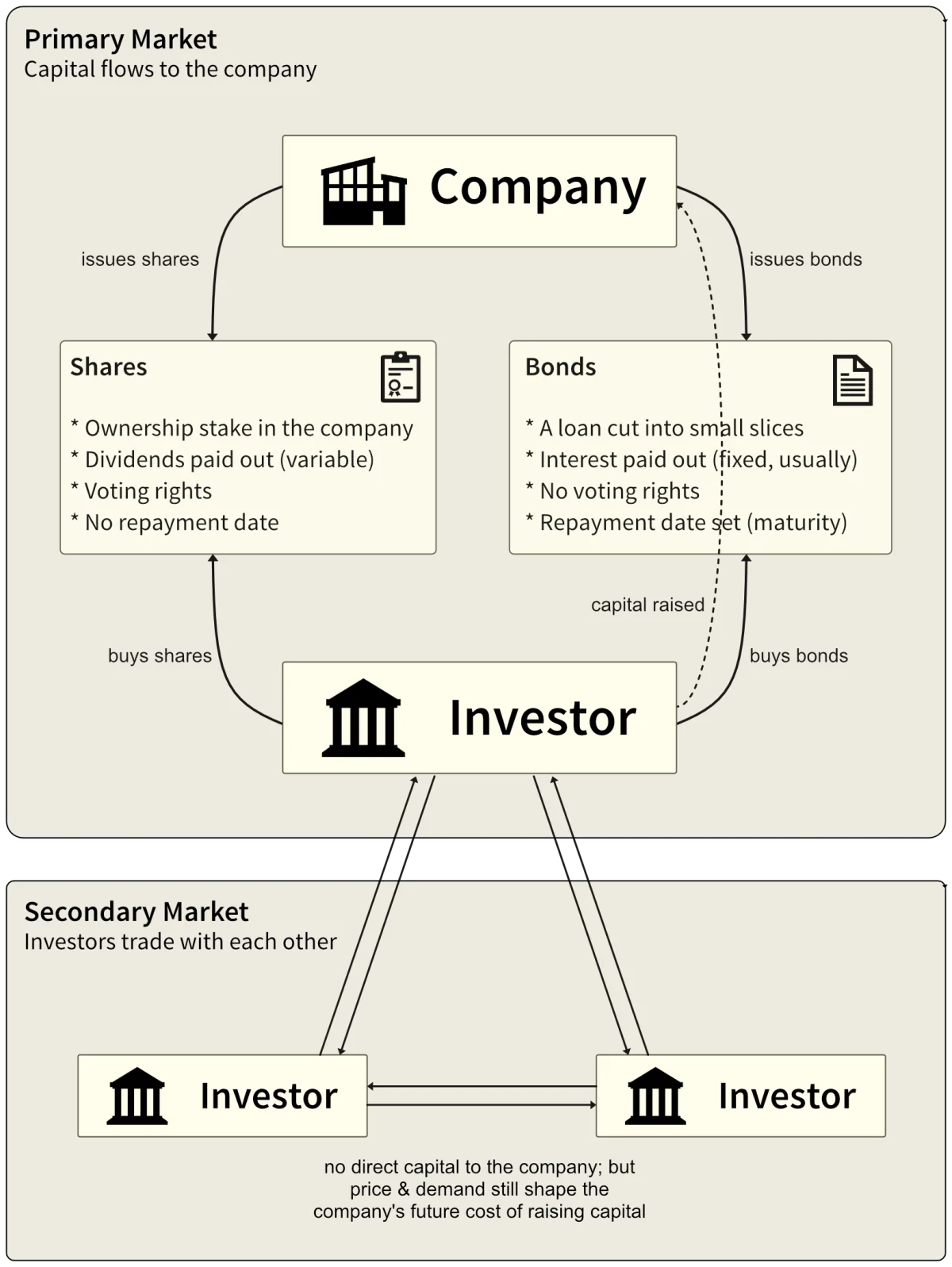
Shares – also called stocks or equity – represent partial ownership of a company. Investors who buy shares in a fossil fuel company become co-owners, gaining rights like voting at annual general meetings. Companies issue shares to raise money; in return, shareholders profit when share prices rise and through dividend payments. This gives institutional investors holding large share positions a direct financial interest in those companies' continued growth and profitability.
Share ownership also shapes a company's ability to raise capital going forward. Buying supports the share price and signals market confidence; selling can drag it down. Because large institutional investors control so much capital, their decisions influence how the market perceives a company – and how easily it can keep financing fossil fuel expansion.
Bonds
Bonds work like loans split into many small pieces investors can buy. Unlike shares, they carry no ownership: a company issuing a bond is borrowing money, agreeing to pay regular interest, then repay the full amount at maturity.
Bond issuances are among the most important ways fossil fuel companies fund large projects, from new oil and gas fields to coal expansion. Because institutional investors hold large volumes of bonds, their participation shapes whether and on what terms companies can access debt markets – the more willing investors are to buy, the cheaper it is for a company to borrow. For a deeper dive, Common Wealth's Bond Villains is a great resource.
Do Investors Actually Finance Companies When They Buy Shares and Bonds?
When a company first issues shares or bonds, it sells them directly to investors and receives capital in return. This is known as the primary market. Once issued, these securities can be bought and sold between investors without money flowing directly to the company. This is known as the secondary market. Some argue that secondary market investors do not finance companies because their purchases do not provide capital directly. But secondary markets still matter, and significantly so. Active demand for a company's shares and bonds supports its market value, improves liquidity, and makes it easier and cheaper for the company to raise capital in the future. The reverse is also true: sustained selling pressure from major investors raises a company’s cost of capital and can constrain its ability to finance new projects.
Beyond the financial mechanics, large institutional investors also confer something less easily measured: legitimacy. When a respected pension fund or sovereign wealth fund holds a company’s securities, it signals that the company is a credible actor worth backing. Divestment campaigns target this endorsement as much as the financial relationship itself. Large shareholders can also influence corporate strategy through voting rights and direct engagement with management. Whether this influence is used to push for genuine emissions reductions or simply to protect returns is a separate question, but the lever exists.
Who Are Institutional Investors?
Institutional investors are organizations that buy, sell, and manage stocks and bonds on behalf of clients or members. They include pension funds, insurance companies, asset managers, hedge funds, sovereign wealth funds, and endowment funds – see below. Because of their scale, institutional investors play an outsized role in financial markets and in shaping which industries receive capital.
Flourish visualizations are embedded on our website to present interactive charts and data stories.
If you access a page with this third-party content, your IP address is transmitted to Flourish so the visualization can be loaded.
We need your consent to display the embedded content from Flourish. You can display this content, and thus all other content from Flourish on our website, with one click and also deactivate it again.What Is Divestment?
Divestment means selling off assets in a particular sector. When an investor divests from fossil fuels, it sells its shares and bonds in coal, oil, and gas companies and commits not to reinvest in them. Divestment campaigns ask institutional investors to make this commitment publicly – sending a clear signal that funding fossil fuels is no longer acceptable.
Divestment works through several channels at once. Financially, when enough investors sell or refuse to buy, it raises the cost of capital for fossil fuel companies, making it more expensive for them to borrow and expand. Reputationally, it stigmatises the industry, shifting the terms of what is considered acceptable investment and putting pressure on institutions that have not yet acted. And politically, divestment reframes fossil fuel financing as a matter of public accountability, not just private portfolio management. As more institutions divest, the reputational and political cost of continued investment rises for those that remain.
The global divestment movement has grown significantly since the early 2010s. Today, thousands of institutions worldwide, including universities, churches, cities, and pension funds, have made full or partial divestment commitments. Understanding who has genuinely committed, and who remains exposed, requires knowing exactly what they hold. That is what our data is for.
What Fossil Fuel Companies Do We Cover?
We use three datasets to define the fossil fuel industry: the Global Coal Exit List (GCEL), the Metallurgical Coal Exit List (MCEL), and the Global Oil & Gas Exit List (GOGEL).
The scope of this research therefore includes companies involved across the entire value chain of coal, oil, and gas production, and in metallurgical coal mining expansion. This includes parent companies and subsidiaries that are also in the fossil fuel business or that are pure financial vehicles. Data is aggregated at the company parent level. Note that some companies appear both on the GCEL and the GOGEL. If data is presented separately for GCEL / GOGEL companies, the investment values cannot be tallied up as this would double-count some investments.
A Note on Metallurgical Coal
The coal used in steel production is known as metallurgical (or "met") coal – an umbrella term covering coking coal and pulverized coal injection (PCI), both of which are used in blast furnaces. This is distinct from thermal coal, which is primarily used for electricity generation and heating. Metallurgical coal accounts for around 13% of global coal consumption.
Steel has long been considered one of the hardest sectors to decarbonize. However, recent technological advances now make coal-free steel production technically feasible: green hydrogen, for instance, can serve as a viable alternative to coal in iron and steel production. According to the think tank Agora Industry, a global phase-out of coal in the steel sector by the early 2040s is achievable from a technical perspective, making continued investment in metallurgical coal expansion increasingly hard to justify.
How to Use Our Data
The Data Tool
Our data tool helps you explore which institutional investors are exposed to fossil fuel companies by holding shares and bonds in fossil fuel companies. You can use it to answer questions such as:
- Which investors are most exposed to fossil fuel companies?
- Which fossil fuel companies receive the most institutional financing?
- How does exposure differ between shareholding and bondholding?
- Which fossil fuel sectors is a specific investor exposed to?
- Which companies headquartered in a specific region receive the most backing from institutional investors?
- ...and much more!
The data tool has two main views that you can toggle between:
Investor View
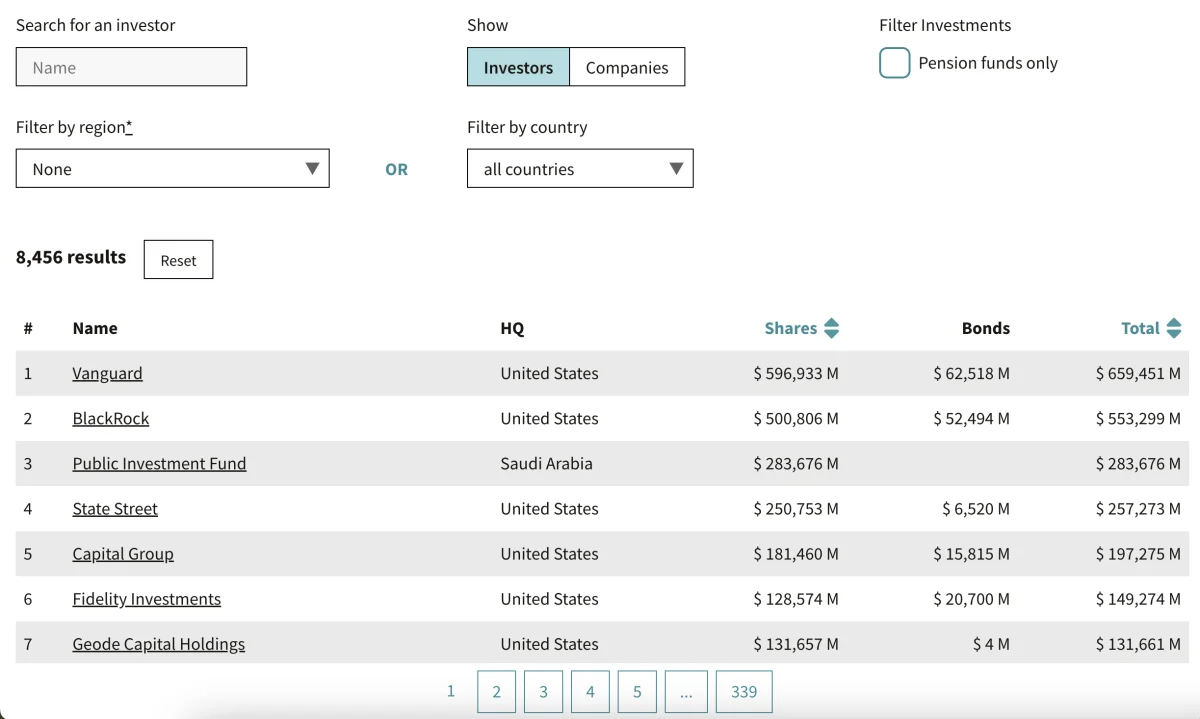
The investor view shows institutional investors ranked by their total holdings in fossil fuel companies. You can search for specific investors, filter by country or region, and narrow the results by investor type (pension funds). Each investor has a dedicated profile page that shows which fossil fuel companies are invested in (you can further refine this by filtering for specific sectors), broken down by shares and bonds. For some private equity firms, we have linked additional information from the Private Equity Energy Tracker at the top, since they may have significantly more fossil fuel involvement than we display here.
Company View
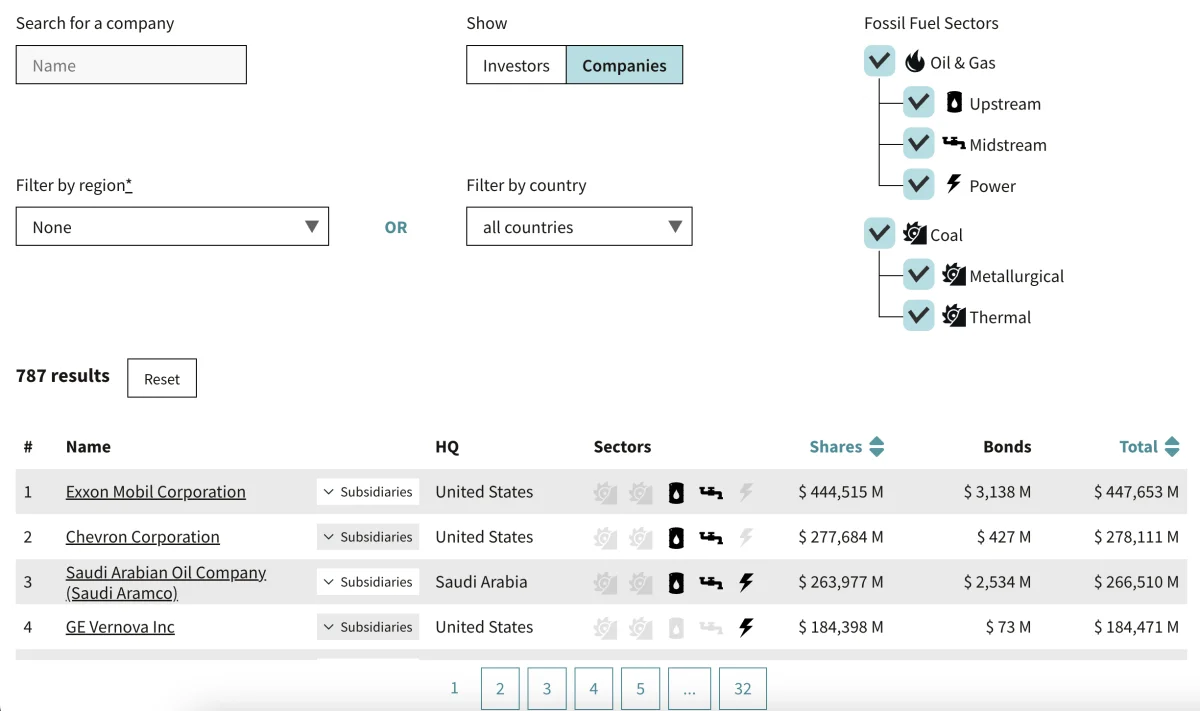
The company view shows fossil fuel companies ranked by the total investments they receive from institutional investors. You can search for specific companies, filter by country or region, and narrow the results by fossil fuel sector. Each company has a dedicated profile page that shows which institutional investors hold their securities (you can further refine this by filtering for pension funds only), broken down by shares and bonds. Company profiles also show information on relevant subsidiaries and figures on fossil fuel production / expansion drawn from the Global Coal Exit List and Global Oil and Gas Exit List. You can download these lists from the respective websites for even more company information. Companies involved in "Reputational Risk Projects" (i.e. projects that are so harmful that they pose a reputational risk to the financial backers of the involved companies) link to further information at the top of their profile.
Understanding the Data's Limits
Financial markets are far from fully transparent, and our data reflects that. Our dataset is the most comprehensive publicly accessible resource on institutional investments in fossil fuel companies that we are aware of – but there are a few important caveats to keep in mind:
- Coverage is uneven across asset types. While shareholding data is nearly complete, bondholding data covers sits at approximately 20-30%. Bond-based rankings may be incomplete and should be interpreted with caution. For this reason, we have disabled ranking by bondholding in our data tool.
- We can only show what is disclosed. All rankings are based on disclosed holdings / publicly available information. Significant parts of financial markets remain opaque, and not all investments are fully reported.
- Rankings reflect exposure, not full responsibility. They indicate financial exposure based on available data – not a comprehensive measure of climate impact or accountability.
- We aggregate data at the investor parent level, meaning investments of different managers owned by one investor parent are combined. This can sometimes obscure where subsidiaries operate with significant independence and the parent may have little practical influence over the subsidiary's holdings.
- Our data contains investments of both asset owners and asset managers (i.e. entities that invest money on behalf of clients). If an investor parent has investment exclusion policies, these may not apply to their asset management arm, which largely has to follow their clients' mandates.
Get in Touch
Whether you are a campaigner, researcher, journalist, or interested individual, we are here to help. Send us an email!
- Data questions: if you want to work with the data and run specific analyses, we can provide you with the data in other formats and help answer any questions. We also hold more detailed data beyond what is published on the website and may be able to provide specific subsets on request.
- Campaign support: if you are working on a campaign, we can help you interpret the data and identify effective ways to use it.
- Press: if you're a journalist working with our data, we can provide further background, data interpretation, and support for media inquiries including interviews and quotes.
Finance Campaigner School

Every year, Urgewald runs a Finance Campaigner School for activists and campaigners who want to deepen their understanding of fossil fuel finance and how to campaign with it. Participants learn how financial markets work, how to use financial data in campaigns, and how to build effective pressure on financial institutions.
Contact us to find out more and how to apply.